Well, every ship takes a fixed number of mps (manufacturing points) to create, based on its hull and components. Each planet can assign its population every turn to 4 separate endeavors:
- wealth (bc)
- research (rp)
- manufacturing/social (mps on the ground = planet hex improvements)
- manufacturing/military (mps to this planet's assigned shipyard = ship building)
So the ship cost in mps, divided by how high you've set your #4 (or the sum of all #4s, for all planets assigned to the same shipyard), determines the build time.
80 turns means you're being inefficient  Consider that by turn 90, I will usually have colonized 6-10 planets, created 2-4 sensor wagons + 10-20 weenies (N.B. a fully loaded small hull fighter is a weenie), made contact with 3-5 other AIs, and have started the tedious process of invading the nearest 1-2 AIs' planets with my dropships. This isn't fast; it's probably only average (among players who micro-manage as maniacally as I do). Anyways, you want to cut your build time down to "a few" turns, where "a few" means 1 weenie per turn from an average forgeworld (that specializes in mps), or 2 turns at most for a constructor, transport, or sensor wagon. (Actually, it's more like 1.5 turns, since every other turn you can dial down your forgeworld to about half military to finish the ship, half something else like research or wealth. It might suck as a research planet, but suck is still better than throwing away your excess production for nothing.)
To cut down your build times (for everything, not just ships), it pays to focus your effort on one goal, and constantly shift goals.
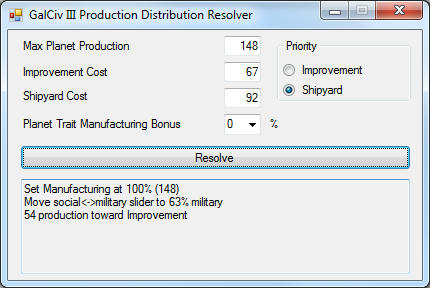
- Build up your worlds first. While your planet has tiles to build, slide its Govern slider max leftward (= 100% social, 0% military), and have it build its own hexes up. Building up a forgeworld (ring of factories around a Solar/Fusion/Antimatter Power Plant) makes it a mid-game weenie-launcher: it can easily reach 100 mp. After your planet finishes its build-out, slide its slider max rightward (= 100% military) and have it build ships. (It may need to build its own shipyard first.) Then it finishes 1 weenie per turn, or 1 constructor (+ some excess) every 2 turns.
- Edit your ship designs. Count space hexes to determine the minimum number of engines + life support you need to get a job done. Design a custom constructor or colony ship with exactly that much, and no more. No point wasting mps and build time on things that will vanish without ever helping you. Don't just settle for the default designs.
Here's a contrast in styles. Suppose your homeworld is doing the default thing of 1/3 population to each of bc/rp/mp, and your Govern manuf slider is at the default 50% (half social, half military). You have 1 hex, 1 ship, and 1 research project all under construction at the same time. Each of the 3 says it will be done in "(3)" turns. You have a choice:
- Method T: Click "Turn" 3 times quickly. You get:
- T+1: nil.
- T+2: nil.
- T+3: A hex, a ship, and a technology.
- Method M: Edit your production every turn to finish 1 item each turn (and dump any excess into the 2nd). You get (for example):
- T+1: A hex (say, a Factory). Choose a new hex to build up (but we'll assume you give it no mps). Adjust again.
- T+2: A tech level (say, a cost reduction to ship building :)) Choose a new technology (but let's assume you give it only excess rps). Adjust again.
- T+3: A ship, plus some excess.
Which path is "better"? That depends on your tolerance for (um) spreadsheets in space. Method T is quick, fast, simple, and can let you whip through hundreds of turns in 1 evening. That's a valid way to enjoy the game, it's probably good enough to beat the placeholder AIs, and it could be great fun to a "visiting" gamer who has dozens of games to choose from every day. Method M is more efficient, because your benefits compound: those 2 extra turns you had that Factory boosting your manufacturing is already a small advantage that the T methodist will never recoup. However, M takes much more tedious effort, up to 20 minutes per turn(!), which is (more than) its own punishment. Somewhere between those two extremes, pick a niche that makes sense to you.





 GalCiv3 Forums
 Consider that by turn 90, I will usually have colonized 6-10 planets, created 2-4 sensor wagons + 10-20 weenies (N.B. a fully loaded small hull fighter is a weenie), made contact with 3-5 other AIs, and have started the tedious process of invading the nearest 1-2 AIs' planets with my dropships. This isn't fast; it's probably only average (among players who micro-manage as maniacally as I do). Anyways, you want to cut your build time down to "a few" turns, where "a few" means 1 weenie per turn from an average forgeworld (that specializes in mps), or 2 turns at most for a constructor, transport, or sensor wagon. (Actually, it's more like 1.5 turns, since every other turn you can dial down your forgeworld to about half military to finish the ship, half something else like research or wealth. It might suck as a research planet, but suck is still better than throwing away your excess production for nothing.)

 .
.